Skyfire co-founder Nitin Bhandari is working on a new approach to cutting our addiction to social media and reducing screen time with a startup called ZenScreen.
The startup has raised $700,000 in funding from Opera (now Otello) and assorted angel investors. It launched iOS and Android apps last month, as well as a Chrome browser extension.
Bhandari, who also served as senior vice president of consumer apps at Opera after the acquisition of Skyfire, said that during his work on mobile browsers and apps, he started to worry about whether creating more engaging — even addictive — apps was a worthwhile goal: “The cognitive dissonance was really eating at me and my team.”
Existing apps lock you out of your browser or smartphone for limited periods of time — for example, I use Forest to cut down on distractions when I need to focus on writing. But Bhandari said the “don’t even touch your phone” approach is “just not practical” for many people.
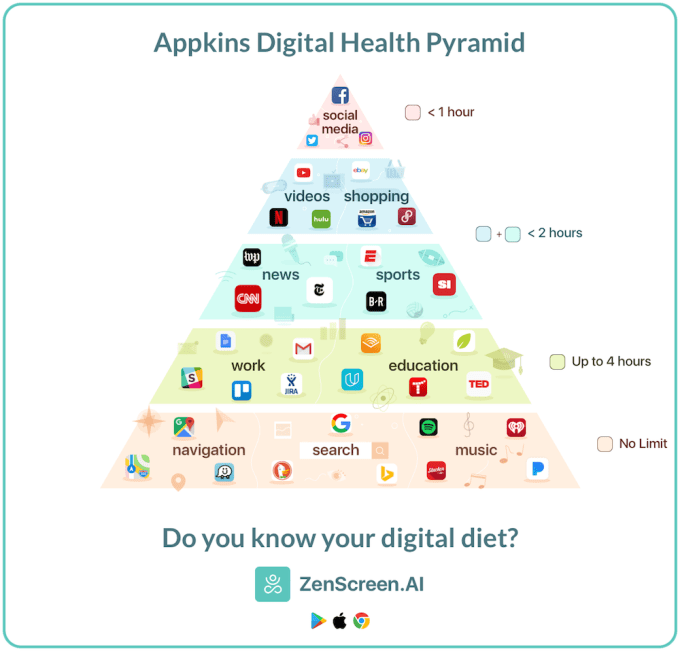
So ZenScreen includes a number of different features that are designed to create what Bhandari said is “almost like a balanced digital diet.” (In fact, ZenScreen created an “AppKins Digital Health Pyramid” showing which apps you can use as much as you want, and others that should be limited.) Adults can use it to control their own app usage, as well as that of their kids.
For example, instead of trying to keep you off your phone for, say, an hour each morning, ZenScreen offers something called Smart Mornings, where you have 10 minutes to access social apps, followed by 20 minutes where you can only open work apps and utilities. Similarly, you can set limits on how much time you spend on social/entertainment apps during the day and restrict social media again when it’s close to bedtime.
To do this, Bhandari said ZenScreen had to solve “a really hard problem to figure out which app is being used and how long it’s in the foreground.” The company uses VPN technology to monitor your app usage, though Bhandari said, “We have a very unique VPN where all of the technology runs right on your device and sensitive data never comes to our servers.”
ZenScreen offers access to personal app usage analytics and its Quiet Time feature for free, then charges $4.99 per month for everything else.
“I actually compare our pricing to a gym membership — that’s kind of what we’re doing for your brain,” Bahndari said. “When you compare it to $80 a month, or $100 a month for the gym, $4.99 seems like such a no brainer if this topic is important to you.”
from Mobile – TechCrunch https://ift.tt/2JhYqbH
Comments
Post a Comment