It seems like everybody wants to jump on the foldable bandwagon these days, and Dell is the latest manufacturer to apparently have such a 2-in-1 in the works, at least if a recently uncovered patent is anything to go by.
The broad idea is for a 2-in-1 which comprises of two portions that support a flexible display (an OLED affair), featuring a central hinge between the aforementioned two portions which is built around “five geared rotational hinge elements” that facilitate the folding action.
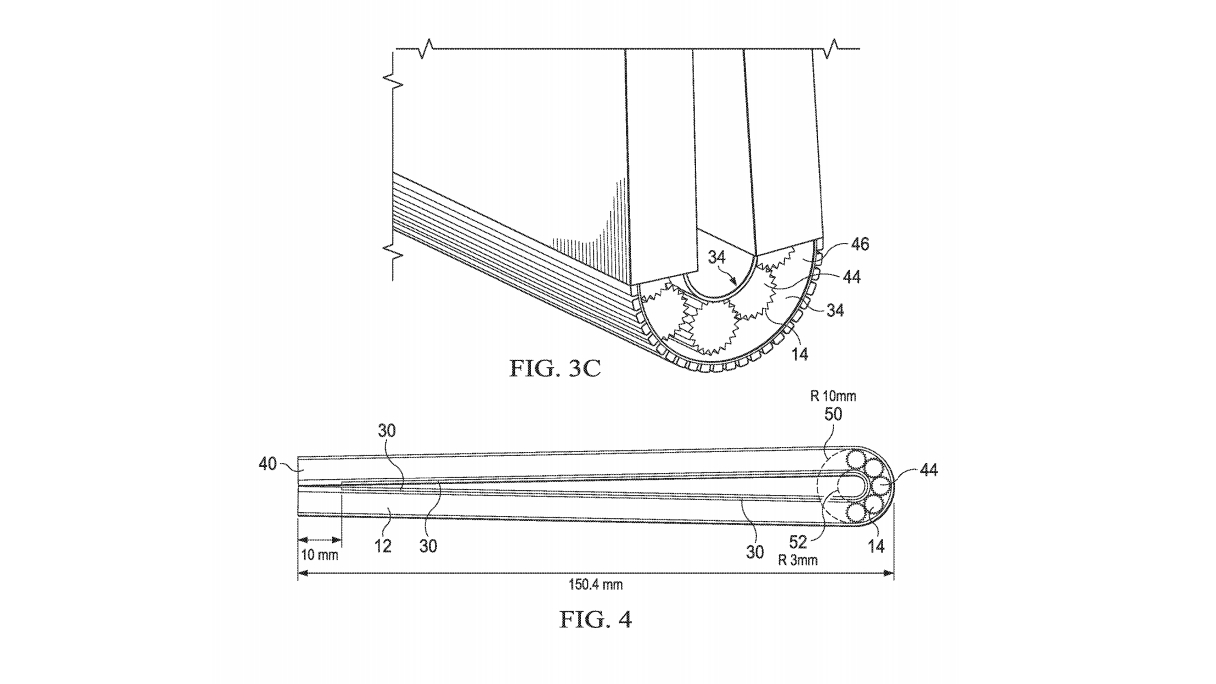
Dell engineers observe: “In order to support OLED film display during folding, OLED film is coupled to a display frame structure having first and second display frames couple together with a flexible support disposed between display frames at the location of the fold of OLED film display.”
Which is a fancy way of saying that the OLED display will be supported and have its integrity maintained by the display frame structure during folding, backed up by a ‘flexible support’ which could possibly be a thin sheet of metal, alloy or plastic.
The patent for this hybrid device was published back in September, but has only just been spotted by Windows Latest .
Flexible friends
The concept is pretty similar to existing solutions like the Royole FlexPai smartphone which was shown off at CES, and consists of two separate displays connected by a hinge element. Lenovo is also working on a foldable laptop with a similar ‘watchband’ style hinge mechanism to the idea Dell is kicking around here.
Lenovo has another patent pointing to a 2-in-1 with a foldable screen, and a leaked video has hinted that a foldable tablet is in the pipeline from Xiaomi, plus Samsung is busy working on laptops with foldable displays.
In short, it very much looks like the future is foldable when it comes the notebooks.
The other major avenue of prototype exploration seems to be dual-screen devices – most notably from Microsoft – although interestingly, last May, a rumor emerged that Dell is planning a dual-screen Windows 10 device powered by a Qualcomm Snapdragon (ARM) chip.
So whether this project, which has reportedly had a prototype on the boil since mid-2017, might eventually tie in with the idea of a foldable display – well, we’ll just have to see.
Image credit: Eustress, Wikimedia Commons
- We’ve picked out the best laptops of 2019
from TechRadar - All the latest technology news http://bit.ly/2MIqXX3
Comments
Post a Comment