
Huawei overtook Samsung in global smartphone shipments for Q2

Things haven’t exactly been smooth sailing for Huawei in recent years. The company’s rapid trajectory has been disrupted by on-going battles with the U.S. government that have, among other things, blocked its access to Google apps and services. But a new report from Canalys paints a reasonably rosy picture as the hardware giant overtook Samsung to snag the top spot in global smartphone shipments for the second quarter of 2020.

The news is a milestone for a number of reasons, not the least of which is the fact that this is first time in nine years that neither Apple nor Samsung has been at the top of Canalys’ charts. Huawei’s figures were almost exclusively boosted by sales in its native China, which currently comprises more than 70% of its total figure.
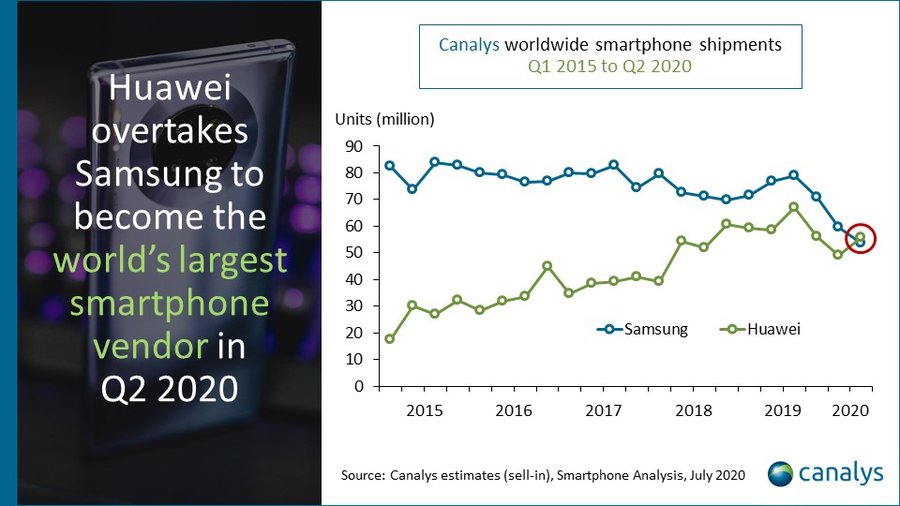
Image Credits: Canalys

It’s important to note here, however, the fact that the company took the top spot by essentially shrinking at a less rapid rate than Samsung. Huawei’s overall figures are down 5% year-over-year. But that figure pales in comparison to Samsung’s 30% drop. The two Goliaths are currently at 55.8 million and 53.7 million, respectively.

Things were bad for the smartphone industry prior to COVID-19, but the pandemic certainly hasn’t helped overall, as people are less inclined toward shelling out hundreds to north of $1,000 for inessential upgrades. And, indeed, Huawei’s numbers dropped by 27% outside of China, but the overall slide was dampened by an 8% growth in China. Samsung, meanwhile, currently controls less than 1% of the Chinese market.

As for what this all means for the future, it seems that it may be difficult for Huawei to maintain its top spot. “Its major channel partners in key regions, such as Europe, are increasingly wary of ranging Huawei devices, taking on fewer models, and bringing in new brands to reduce risk” Canalys’ Mo Jia said of the report. “Strength in China alone will not be enough to sustain Huawei at the top once the global economy starts to recover.”


from Mobile – TechCrunch https://ift.tt/3f7SM7K

Comments

Popular posts from this blog

The future of Magic Leap's promising AR efforts dim after layoffs

The Magic Leap Two is now further away than ever, unfortunately. Today in a blog post the augmented reality pioneer announced major layoffs and has decided to cut up to half of its workforce, according to some reports. The original Magic Leap One was supposed to be one of the first mainstream augmented reality headsets when it launched in 2018, but a high price point and lack of interest from developers left the headset high and dry after launch. According to the blog post, Magic Leap says it will be focusing its efforts on enterprise solutions (a statement HTC has made recently as well) and shift its focus away from consumer technology… at least for the time being.  The company has been open about creating a second headset that would offer improved specs for some time, but how that work will now have to go forward without half of the team , according to some estimates, remains to be seen. Is the window closing on augmented reality?  Although it’s just one company, Magic...

Airship acquires SMS commerce company ReplyBuy

Airship is announcing that it has acquired mobile commerce startup ReplyBuy . The startup (which was a finalist at TechCrunch’s 1st and Future competition in 2016) works with customers like entertainment venues and professional and college sports teams to send messages and sell tickets to fans via SMS. It raised $4 million in funding from Sand Hill Angels, Kosinski Ventures, SEAG Ventures, Enspire Capital, MRTNZ Ventures and others, according to Crunchbase . Airship, meanwhile, has been expanding its platform beyond push notifications to cover customer communication across SMS, email, mobile wallets and more. But CEO Brett Caine said this is the first time the company is moving into commerce. While sports and concerts tickets might not be a booming market right now, Caine suggested that the company is actually seeing increased purchasing activity “in and around the Airship platform” as businesses try to drive more in-app purchases. He also suggested that both the COVID-19 pandem...