
Smartphone shipments dropped 13% globally, and COVID-19 is to blame

We knew it was going to be bad — but not necessarily “lowest level since 2013” bad. As Apple was busy reporting its earnings, Canalys just dropped some of its own figures — and they’re not pretty. After two quarters of much-needed growing, the global smartphone market just took a big hit. And you no doubt already know who the culprit is.

The mobile industry joins countless others that have taken a massive hit due to the COVID-19 pandemic, with shipments dropping 13% from this time last year. Here’s a graph for those of you who are visual learners:
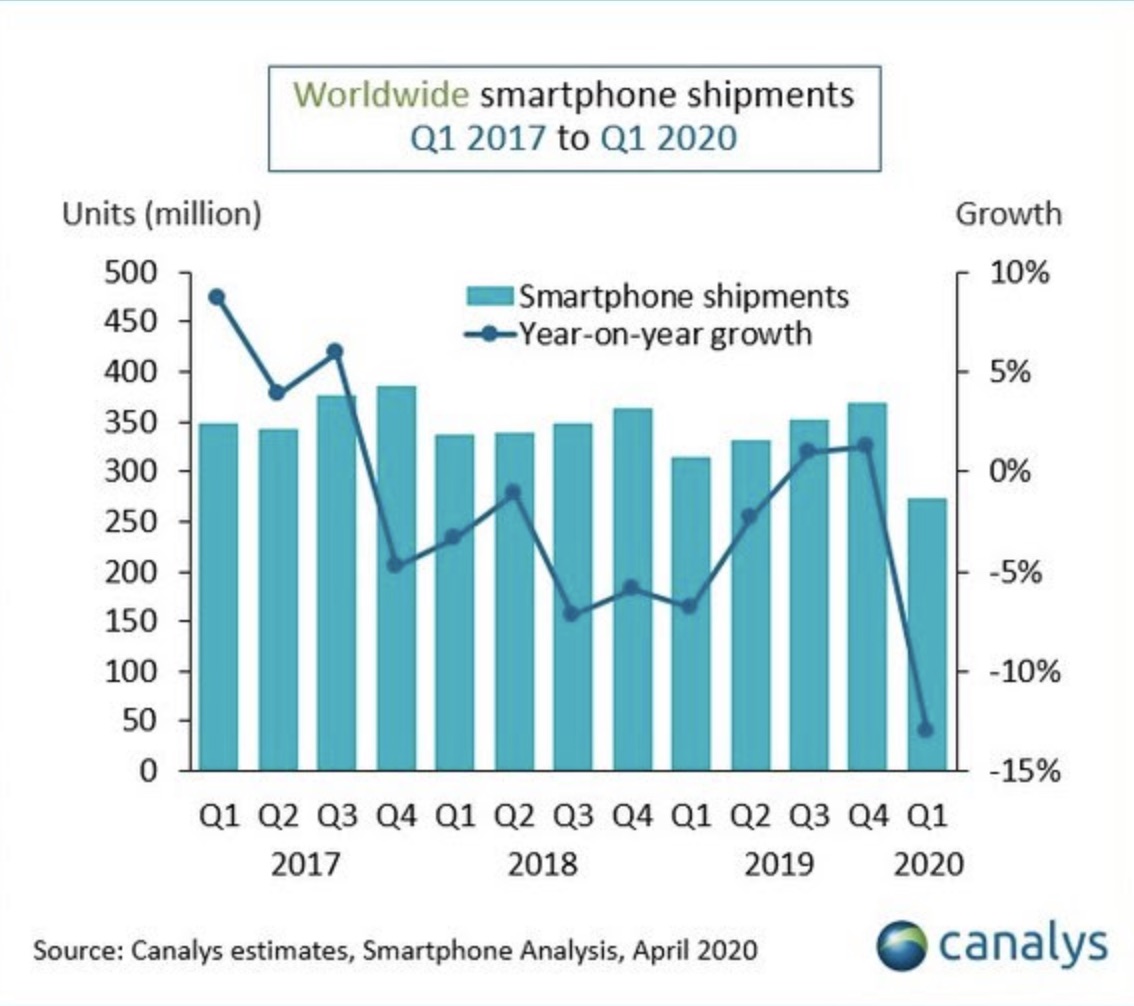
Analyst Ben Stanton used the word “crushed” to describe the novel coronavirus’s impact on the mobile market. “In February, when the coronavirus was centered on China, vendors were mainly concerned about how to build enough smartphones to meet global demand,” he writes. “But in March, the situation flipped on its head. Smartphone manufacturing has now recovered, but as half the world entered lockdown, sales plummeted.”

First it was impact on the global supply chain, which is centered in Asia, along with a drop in demand among consumers in China. As Europe, the U.S. and other locations continue to live under shelter in place order, demand in those markets has taken a significant hit. People are stuck inside and many have lost jobs — it’s not really the ideal time to consider shelling out $1,000+ for what still seems a luxury for many.

Samsung regained the top spot, while still losing significant numbers. Both it and the number two company, Huawei, were down 17% for the quarter. Apple, at number three, dropped 8%. Chinese manufacturers Xiaomi and Vivo saw some gains, at 9- and 3%, respectively.

There are bound to be rough times ahead as well. Per Stanton, “Most smartphone companies expect Q2 to represent the peak of the coronavirus’ impact.” Apple noted the uncertainty of its own earnings by opting not to issue guidance for next quarter.



from Mobile – TechCrunch https://ift.tt/3c4tG9f

Comments

Popular posts from this blog

The future of Magic Leap's promising AR efforts dim after layoffs

The Magic Leap Two is now further away than ever, unfortunately. Today in a blog post the augmented reality pioneer announced major layoffs and has decided to cut up to half of its workforce, according to some reports. The original Magic Leap One was supposed to be one of the first mainstream augmented reality headsets when it launched in 2018, but a high price point and lack of interest from developers left the headset high and dry after launch. According to the blog post, Magic Leap says it will be focusing its efforts on enterprise solutions (a statement HTC has made recently as well) and shift its focus away from consumer technology… at least for the time being.  The company has been open about creating a second headset that would offer improved specs for some time, but how that work will now have to go forward without half of the team , according to some estimates, remains to be seen. Is the window closing on augmented reality?  Although it’s just one company, Magic...

Airship acquires SMS commerce company ReplyBuy

Airship is announcing that it has acquired mobile commerce startup ReplyBuy . The startup (which was a finalist at TechCrunch’s 1st and Future competition in 2016) works with customers like entertainment venues and professional and college sports teams to send messages and sell tickets to fans via SMS. It raised $4 million in funding from Sand Hill Angels, Kosinski Ventures, SEAG Ventures, Enspire Capital, MRTNZ Ventures and others, according to Crunchbase . Airship, meanwhile, has been expanding its platform beyond push notifications to cover customer communication across SMS, email, mobile wallets and more. But CEO Brett Caine said this is the first time the company is moving into commerce. While sports and concerts tickets might not be a booming market right now, Caine suggested that the company is actually seeing increased purchasing activity “in and around the Airship platform” as businesses try to drive more in-app purchases. He also suggested that both the COVID-19 pandem...